

We’re one of 15 science centres across the UK delivering the new Demystifying AI programme!
Find out more about the project in our news post, find out more about the local experts we’re featuring, and take part in our upcoming livestream and in-person events!
We’re working with local experts to explore what AI is, how it works, how people locally are using AI to make a difference, and what it means for people and the planet.
In-person events
We’re bringing the Demystifying AI experience to community spaces in March and April!
Upcoming events:
- Saturday 11 April (Easter school holidays) – Green Lanes shopping centre – Barnstaple (stay notified via the Facebook event)
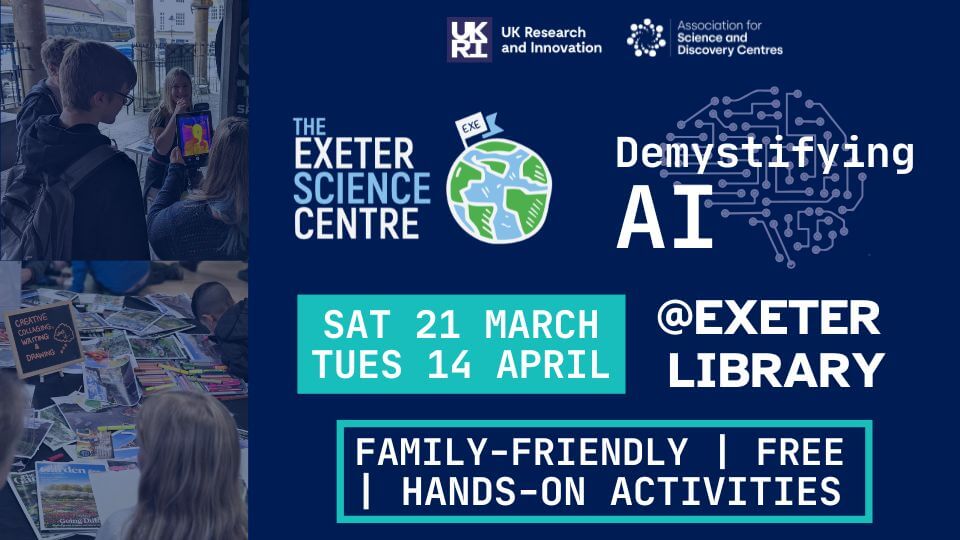
Tuesday 14 April (Easter school holidays) – Exeter Library (stay notified via the Facebook event)

Previous events:
Saturday 14th March – Hatherleigh Science Fair
Saturday 21st March – Exeter Library
Livestreams
Over the coming month, we’re running livestream events where we ask YOUR questions to local experts!
Upcoming livestreams:
- Weds 15 April, 7pm: Prof Tarje Nissen-Meyer – AI for Good: mapping Earth’s soils with seismology & AI. Watch on YouTube, Facebook or LinkedIn.
- Thurs 23 April, 7pm: Prof Travis Coan – AI in society: climate, politics and misinformation. Links coming soon.
We’re announcing new livestreams in the coming weeks, but in the meantime, check out our brilliant livestream discussions so far:
Tips for using AI
As we go through this project, we’re gathering tips, as well as advice from local experts, for all of us about how we use AI.
To start with, here’s our ‘AI takeaway’ from our in-person events, which summarises how we’d suggest working with AI chatbots:

We also had some useful tips, reflections and links from our recent livestreams which we’ll share here:
– Remember that AI chatbots are not conscious – they are sophisticated text-prediction machines, and you always need to check what they come out with – it may not be correct.
– We should all be critical AI users at an individual and collective level. We have agency in how AIs are regulated and developed, and we should use our agency to influence the kind of world we want to live in with AI.
More coming soon!
Local Inspiration
We’re working with local experts to highlight the amazing variety of research and industry using or studying AI in the region, to make a difference for people and the planet. Find out more about some of the people we’re working with below!

Prof Ed Keedwell studied for a degree in Cognitive Science followed by a PhD in Computer Science, becoming a Professor of Artificial Intelligence in 2019. He has research interests in optimisation, machine learning and AI-based simulation – and their application to problems in bioinformatics and engineering. His areas of current interest include the optimisation of transportation systems and water systems, and human-in-the-loop optimisation methods, for applications in engineering.
Find out more about Ed on his webpage, and on our first livestream!

Dr Lucy Osler is a Lecturer in Philosophy at the University of Exeter. Lucy looks at why we form relationships with AI companions, even when we know they aren’t real people. Her research explores how AI and digital technology impact our emotions, social connections, and mental health. Using philosophy, she examines everyday experiences, from finding belonging in online communities to falling in love with chatbots.
Find out more about Lucy on her webpage, and on our second livestream!

Prof. Joel Krueger is an Associate Professor in Philosophy at the University of Exeter. Joel is interested in how AI companions offer users spaces for emotional support and exploration. His research has focused, in particular, on the use of AI in the context of grief and dementia, as well as thinking through the ways in which AI companions may offer possibilities for authentic self-expression for marginalised individuals.
Find out more about Joel on his webpage and on our second livestream!

Dr Federico Botta is a Senior Lecturer in Data Science at the University of Exeter. He uses large amounts of data collected from interactions with the internet, mobile phones and tracking sensors to investigate different aspects of human behaviour. He specialises in using AI to tackle real-world challenges, particularly in reducing inequalities in urban transport. He is currently working on using better data and data science methods to improve transport systems and policies. He is particularly passionate about how data science and AI can be used to support the policy making process.
Find out more about our work with Federico here, and Federico’s work on his webpage.

Mahdis Tourian is a PhD researcher in Environmental Intelligence at the University of Exeter, with a background in Industrial Engineering and an MBA.
Mahdis’ research focuses on using artificial intelligence to improve how ecological data is collected, analysed, and used to support nature recovery. Working with partners such as Natural England and Natural Resources Wales, she develops practical, user-friendly AI tools to help make biodiversity evidence more accessible for conservation planning and policy. Find out more about Mahdis in a recent article on the AI For Collective Intelligence webpage!

Prof Travis Coan is a Professor in Computational Social Science at the University of Exeter who uses AI to study the integrity of climate information. He is a co-director at the Centre for Climate Communication and Data Science and has spent over 10 years working on how computers interpret and generate human language. He has co-produced a tool which uses a large language model to examine text and videos to tackle misinformation around climate change.
Find out more about Travis on his webpage, and stay tuned for our upcoming livestream in April!

Dr Jonathan Phillips is a Senior Lecturer and UKRI Future Leaders Fellow at the Living Systems Institute, University of Exeter, where he studies how proteins move and change shape – and why this matters for health and disease. He completed his PhD in Chemistry at the University of Cambridge, before holding research positions at AstraZeneca and the Alan Turing Institute.
Alongside his academic work, he works with the biotechnology industry and non-profits to translate fundamental science into new medicines and diagnostics. More information can be found at his group webpage, Google Scholar, and LinkedIn.
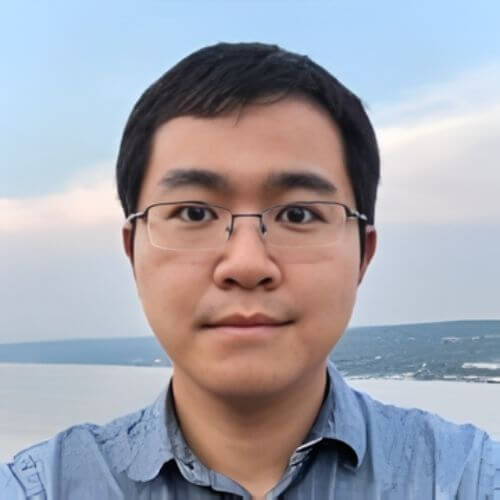
Prof Shiqiang Wang is a Professor of Artificial Intelligence in the Department of Computer Science at the University of Exeter. He explores how to combine AI with distributed computing (connecting multiple computers to work together).
He also works on optimising AI systems to improve model training and inference, as well as how we build and use tools like Large Language Models (LLMs) and agentic AI (systems that can act independently to solve tasks). As the leader of the CORE-AIx Lab, Professor Wang works on creating the next generation of reliable and efficient AI. Find out more about Shiqiang’s work on his website.

Prof. Kirstine Dale is the Met Office’s Chief AI Officer and Principal Fellow for Data Science. She is also a Fellow at The Alan Turing Institute and an Honorary Professor at the University of Exeter. Kirstine has a multidisciplinary background, spanning natural and social sciences. Her work focuses on the use of AI in weather forecasting, climate modelling and how we get information to decision-makers when, and how, they need it. Kirstine helps to shape the future of Data Science (including Artificial Intelligence and Machine Learning) at the Met Office. She is also part of the Exeter Science Centre Strategic Advisory Board!
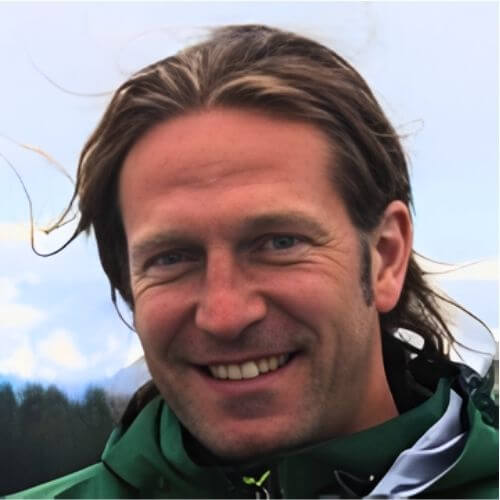
Prof Tarje Nissen-Meyer is a Professor in Environmental Intelligence at the University of Exeter. Trained as a geophysicist, his research is focused on seismology, which he recently applied to studying ecosystems; from African elephants (who communicate using vibrations through the ground) to soil health.
He uses data science, machine learning and AI to help process the huge amounts of data needed to study these systems, and to make human-friendly interfaces with it. Alongside our charity’s Patron, George Monbiot, Tarje is co-founder of the Earth Rover Program – an ambitious project to map all of Earth’s soils, to help with regenerating ecosystems and support farmers to make the right choices for their crops and the environment. Find out more about Tarje on his webpage.
